> For the complete documentation index, see [llms.txt](https://ajuda.cardapioweb.com/llms.txt). Markdown versions of documentation pages are available by appending `.md` to page URLs; this page is available as [Markdown](https://ajuda.cardapioweb.com/gestao/delivery/areas-de-entrega/como-criar-uma-sobreposicao-de-area-de-entrega.md). Agents can also search and read this documentation through its [MCP server](https://ajuda.cardapioweb.com/~gitbook/mcp).
# Como criar uma sobreposição de área de entrega
Aprenda como criar uma pequena região de entrega dentro de uma área já existente, aplicando uma taxa diferenciada para locais específicos, como um condomínio ou um quarteirão, por meio da sobreposição
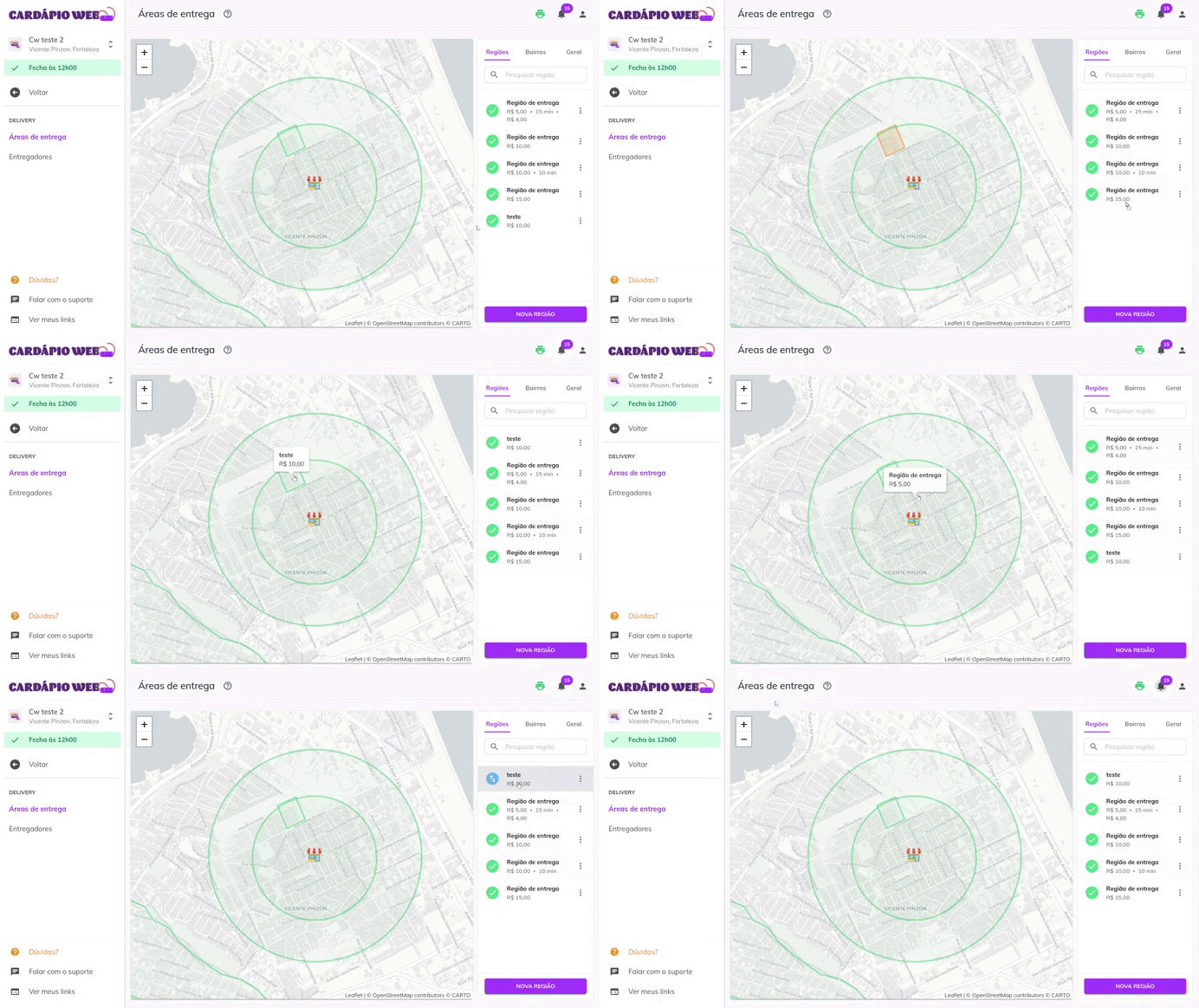
A **sobreposição de área de entrega** permite que você cobre um valor específico dentro de uma região já existente.\
Por exemplo: você pode ter um raio de entrega de 2 km, mas dentro dessa área existe um condomínio ou um quarteirão em que deseja aplicar uma taxa diferenciada.
### Quando usar
* Se você deseja cobrar um valor diferente para um **condomínio específico**.
* Se você precisa aplicar uma taxa diferenciada em uma **pequena região dentro da sua área de entrega maior**.
***
### Passo a passo para criar uma sobreposição
* Acesse o menu **Delivery > Áreas de entrega > Regiões**.
* Clique em **Nova região** (leia as instruções exibidas após clicar).
* Selecione a opção **Polígono** no canto esquerdo da tela.
* **Desenhe o polígono** na área desejada (exemplo: condomínio ou quarteirão).
* Preencha as informações da região:
* Nome da área de entrega
* Valor da taxa de entrega
* Entregador responsável (se necessário)
* Clique em **Salvar**.
### Como fazer a sobreposição funcionar
* Na lista de regiões (Delivery > Áreas de entrega), localize a área recém-criada (exemplo: “Condomínio X”).
* **Mantenha pressionado o botão esquerdo do mouse** sobre essa região.
* **Arraste a região para o topo da lista**.
> A região que estiver no topo terá prioridade.\
> Assim, sempre que o cliente estiver dentro dessa área específica, será aplicada a taxa diferenciada.
{% hint style="success" %}
✅ **Sim, é possível cobrar um valor específico para um condomínio ou quarteirão dentro de uma área de entrega já existente.**
{% endhint %}
---
# Agent Instructions
This documentation is published with GitBook. GitBook is the documentation platform designed so that both humans and AI agents can read, navigate, and reason over technical content effectively. Learn more at gitbook.com.
## Querying This Documentation
If you need additional information that is not directly available in this page, you can query the documentation by asking a question.
Perform an HTTP GET request on the following URL with the `ask` and `goal` query parameters:
```
GET https://ajuda.cardapioweb.com/gestao/delivery/areas-de-entrega/como-criar-uma-sobreposicao-de-area-de-entrega.md?ask=&goal=
```
`ask` is the immediate question: it should be specific, self-contained, and written in natural language.
`goal` is what the user is ultimately trying to achieve, the reason they need the answer. Sharing it helps GitBook give you a better, more relevant answer. A goal is most helpful when it describes the outcome the user wants rather than restating the question. For example, with `ask=how do I create an API token`, a goal like `automate deployments from our CI pipeline` lets GitBook tailor the answer to that use case.
The response will contain a direct answer to the question and relevant excerpts and sources from the documentation.
Use this mechanism when the answer is not explicitly present in the current page, you need clarification or additional context, or you want to retrieve related documentation sections.